Post
The Illusion of Explanatory Depth
Have you heard of ‘The Bible’?’
Think you know the basics about it?
You may have been reading it for decades, and might be able to recite dozens of verses by heart!
But what if I said your feelings of knowledge are an illusion?
That we don’t know things as well as we think we do?
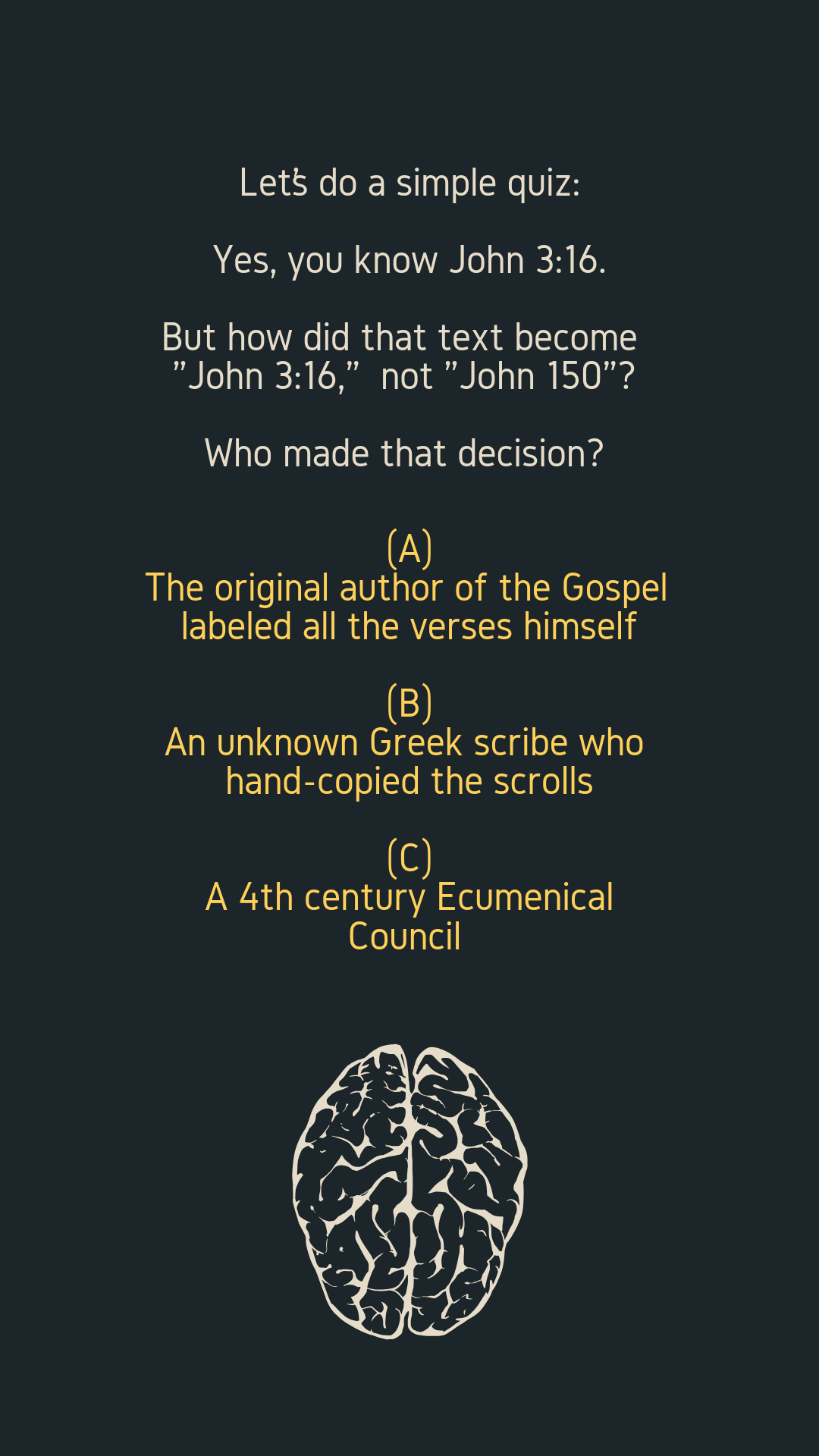
Let’s do a simple quiz:
Yes, you know John 3:16.
But how did that text become “John 3:16,” not “John 150”?
Who made that decision?
(A) The original author of the Gospel labeled all the verses himself (B) An unknown Greek scribe who hand-copied the scrolls? (C) Decided by a 4th century Ecumenical council
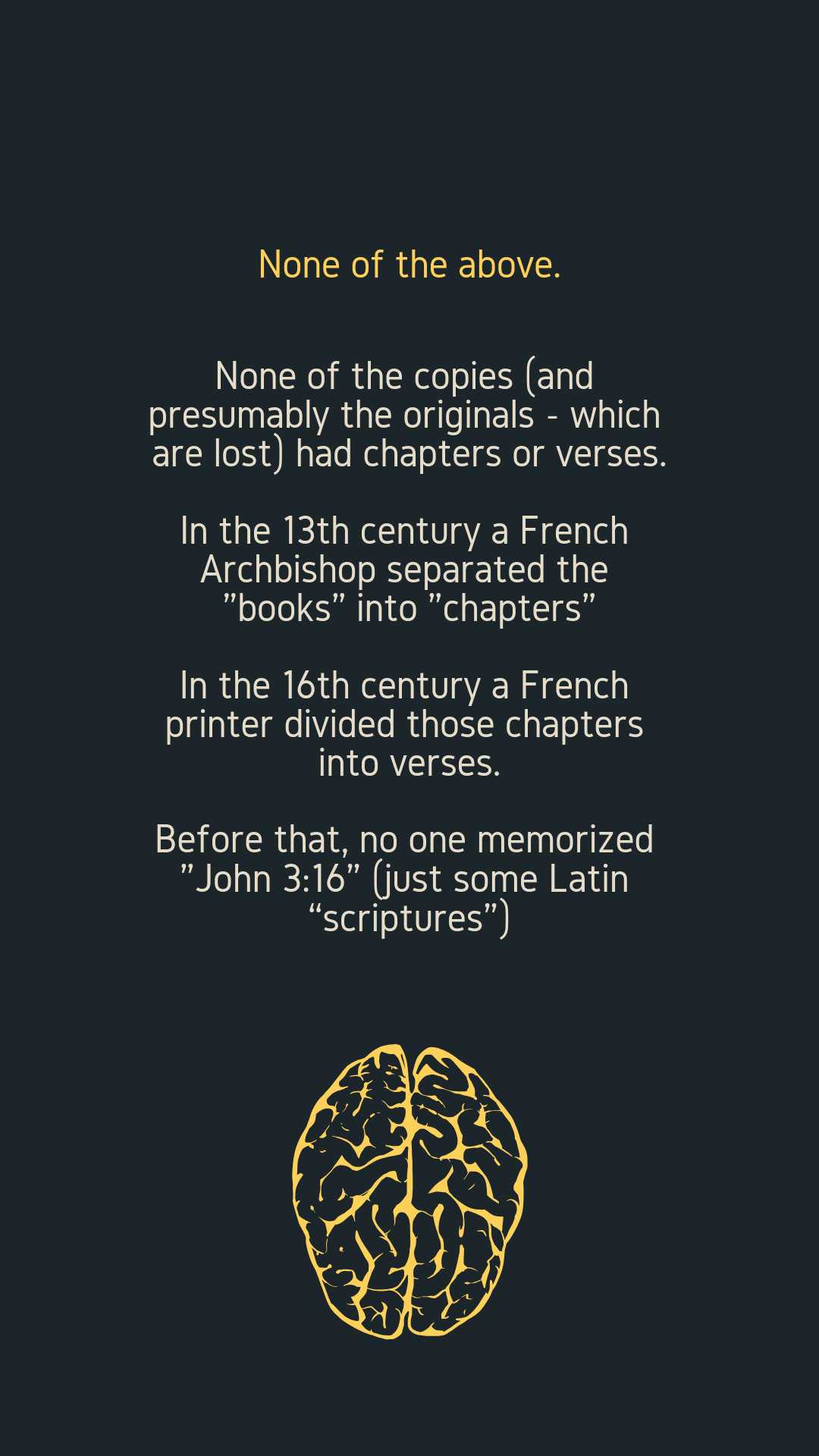
None of the above.
None of the copies (and presumably the originals - which are lost) had chapters or verses. In the 13th century a French Archbishop separated the “books” into “chapters” In the 16th century a printing shop divided those chapters into verses.
Before that, no one memorized “John 3:16” (just some Latin “scriptures”)
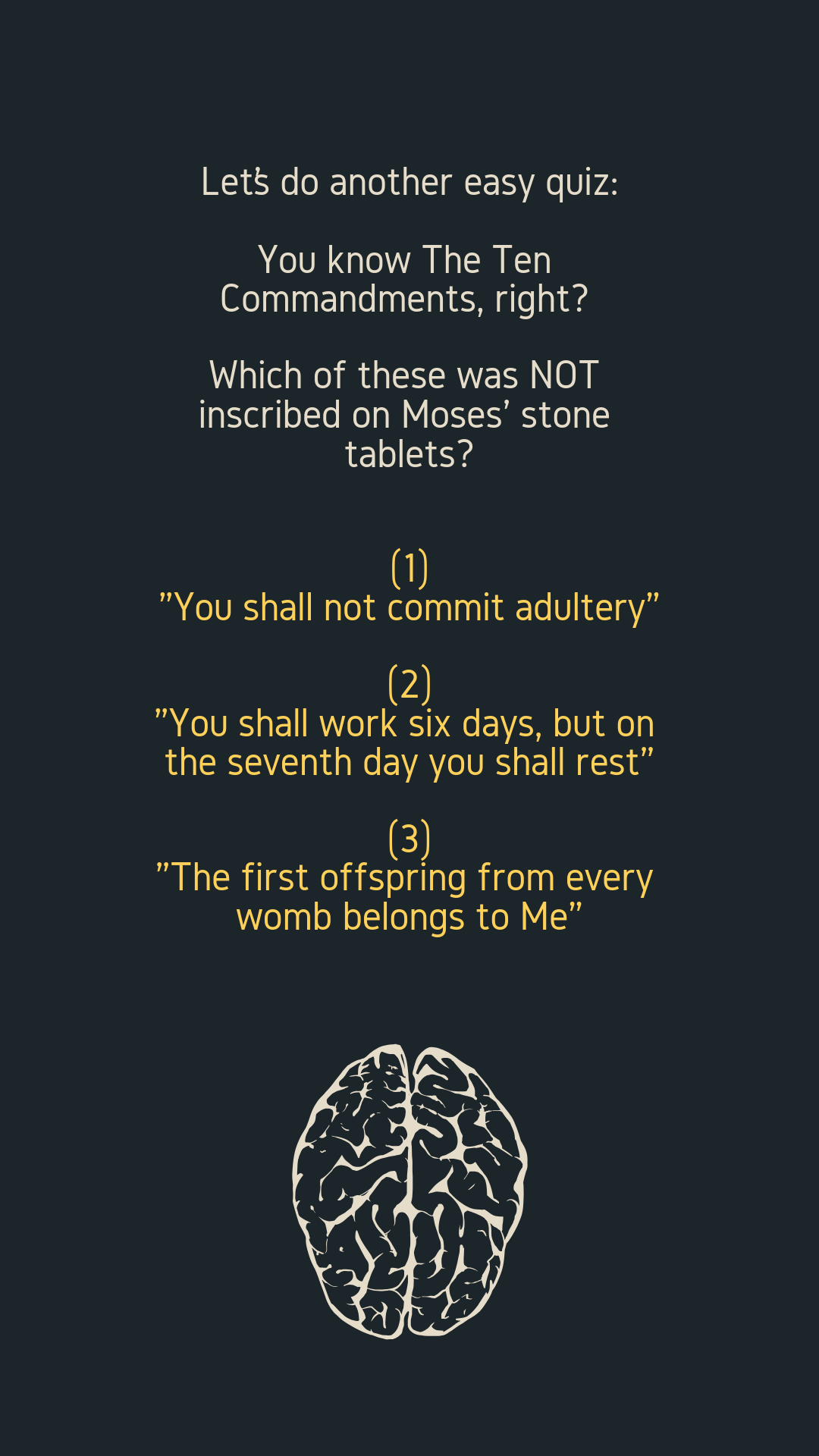
Let’s do another easy quiz:
You know The Ten Commandments, right? Which of these was NOT inscribed on Moses’ stone tablets?
- You shall not commit adultery.
- You shall work six days, but on the seventh day you shall rest
- The first offspring from every womb belongs to Me,
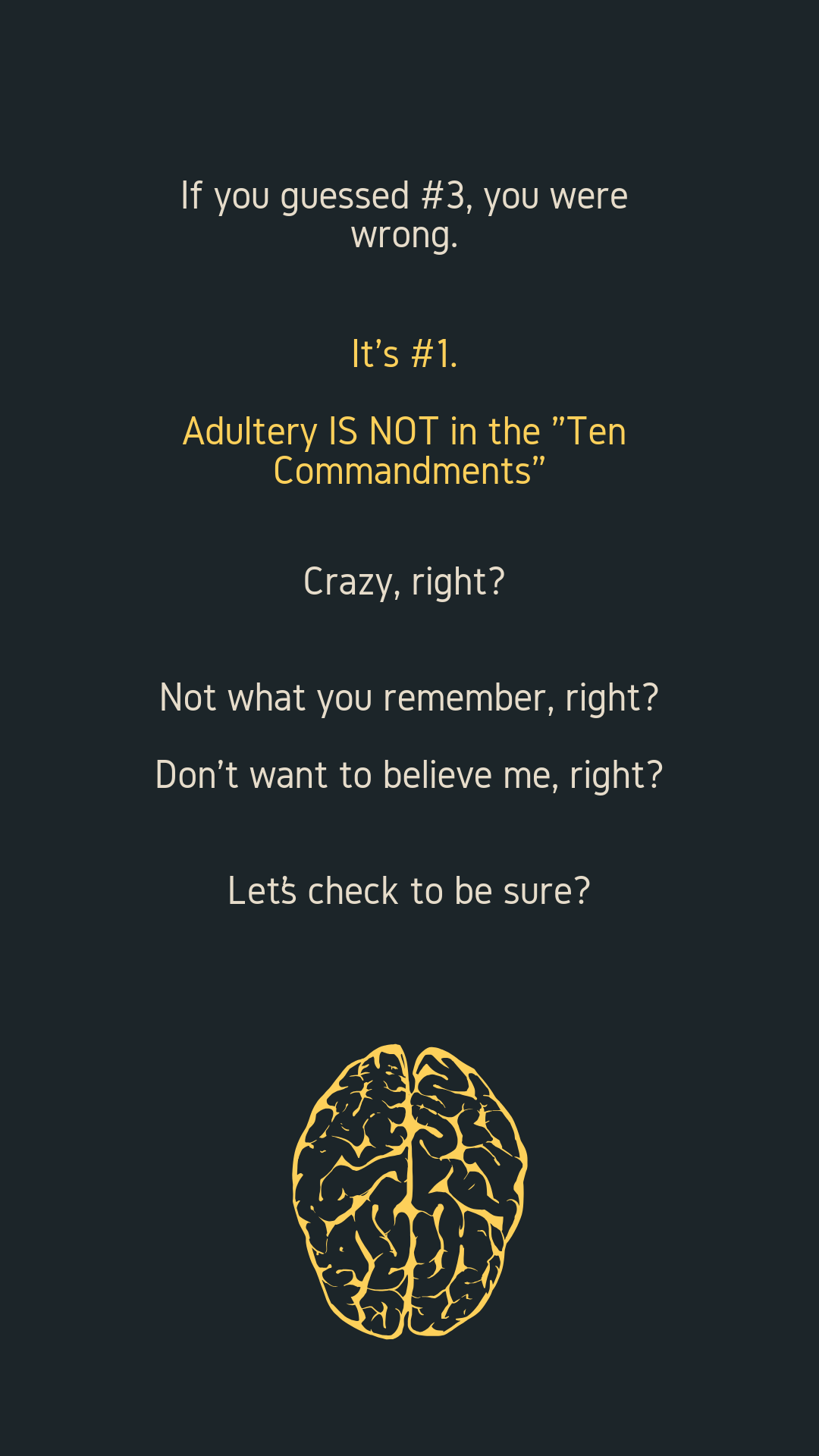
If you guessed #3, you were wrong.
It’s #1. Adultery IS NOT in the “Ten Commandments”
Crazy, right? Not what you remember, right? Don’t want to believe me, right?
Let’s check to be sure?
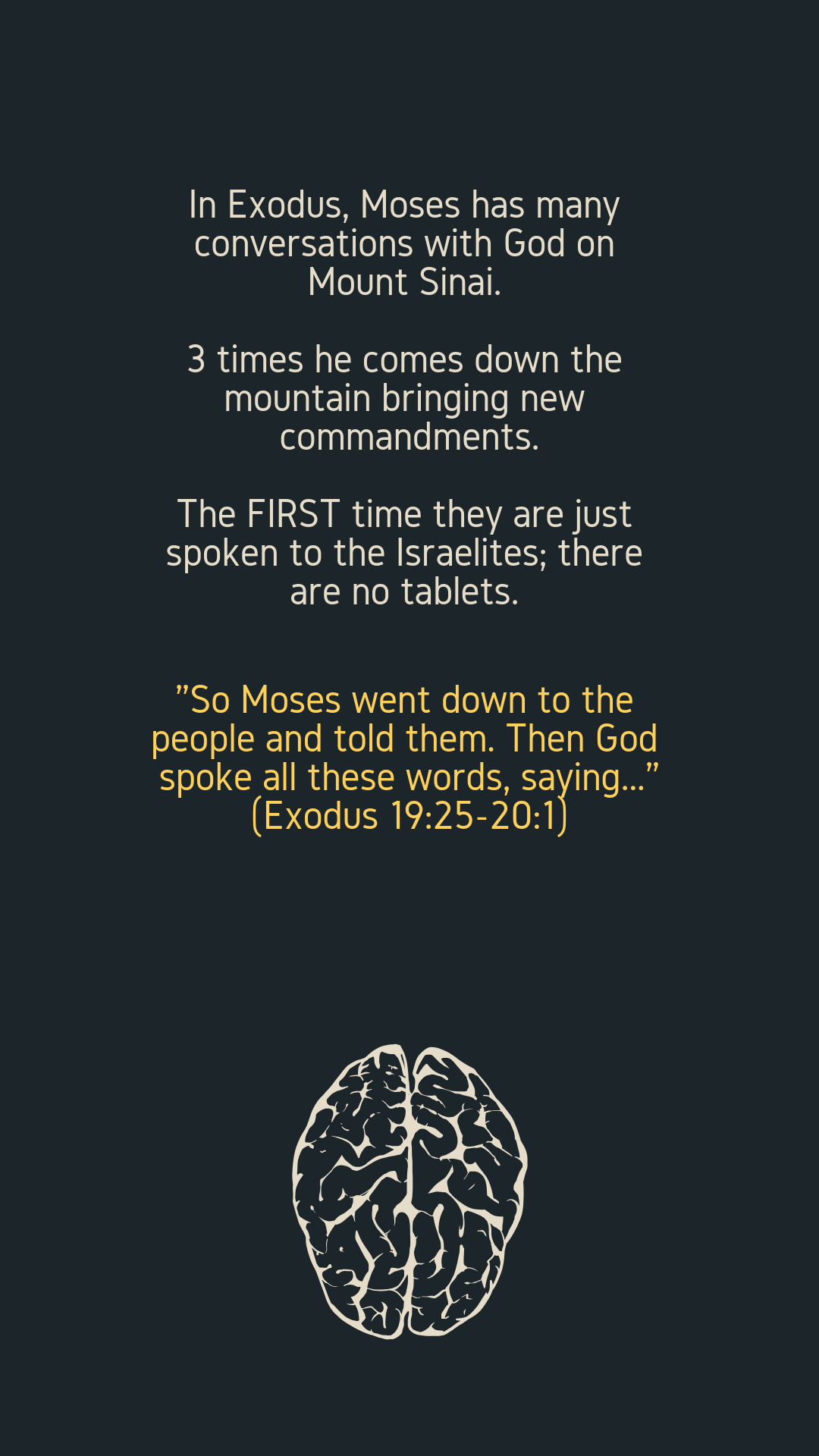
In Exodus, Moses has many conversations with God on Mount Sinai. 3 times he comes down the mountain bringing new commandments.
The first time they are just spoken to the Israelites; there are no tablets. “So Moses went down to the people and told them. Then God spoke all these words, saying…” (Exodus 19:25-20:1)
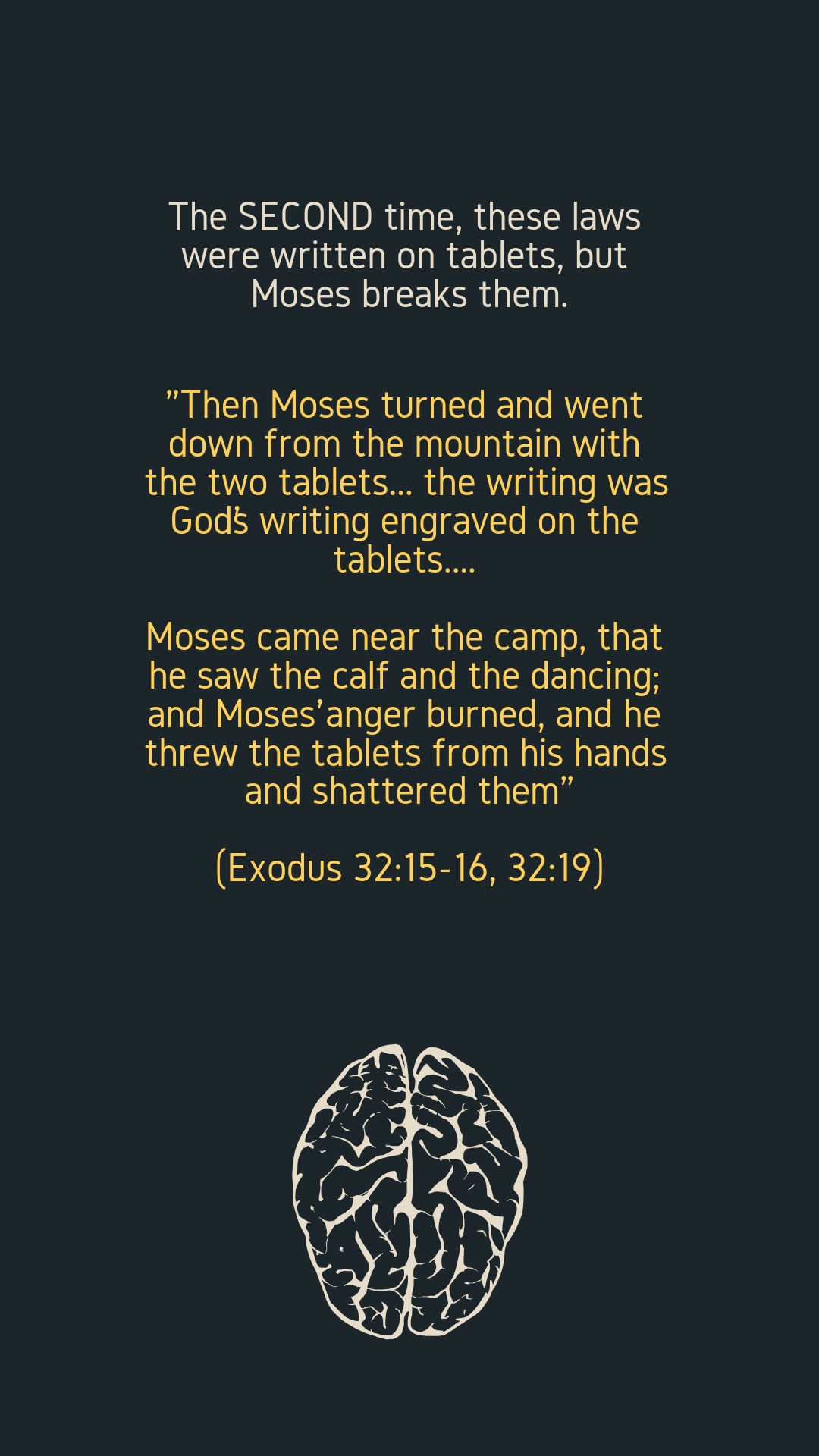
The second time, these laws were written on tablets, but Moses breaks them.
“Then Moses turned and went down from the mountain with the two tablets… the writing was God’s writing engraved on the tablets… Moses came near the camp, that he saw the calf and the dancing; and Moses’ anger burned, and he threw the tablets from his hands and shattered them” (Exodus 32:15-16, 32:19)
The third time, the commandments from the broken tablets are rewritten onto new tablets. And these are finally called “The Ten Commandments”
“Now the Lord said to Moses, “Cut out for yourself two stone tablets like the former ones, and I will write on the tablets the words that were on the former tablets which you shattered” (Exodus 34:1)
“And he wrote on the tablets the words of the covenant, the Ten Commandments.” (Exodus 34:27-28).”
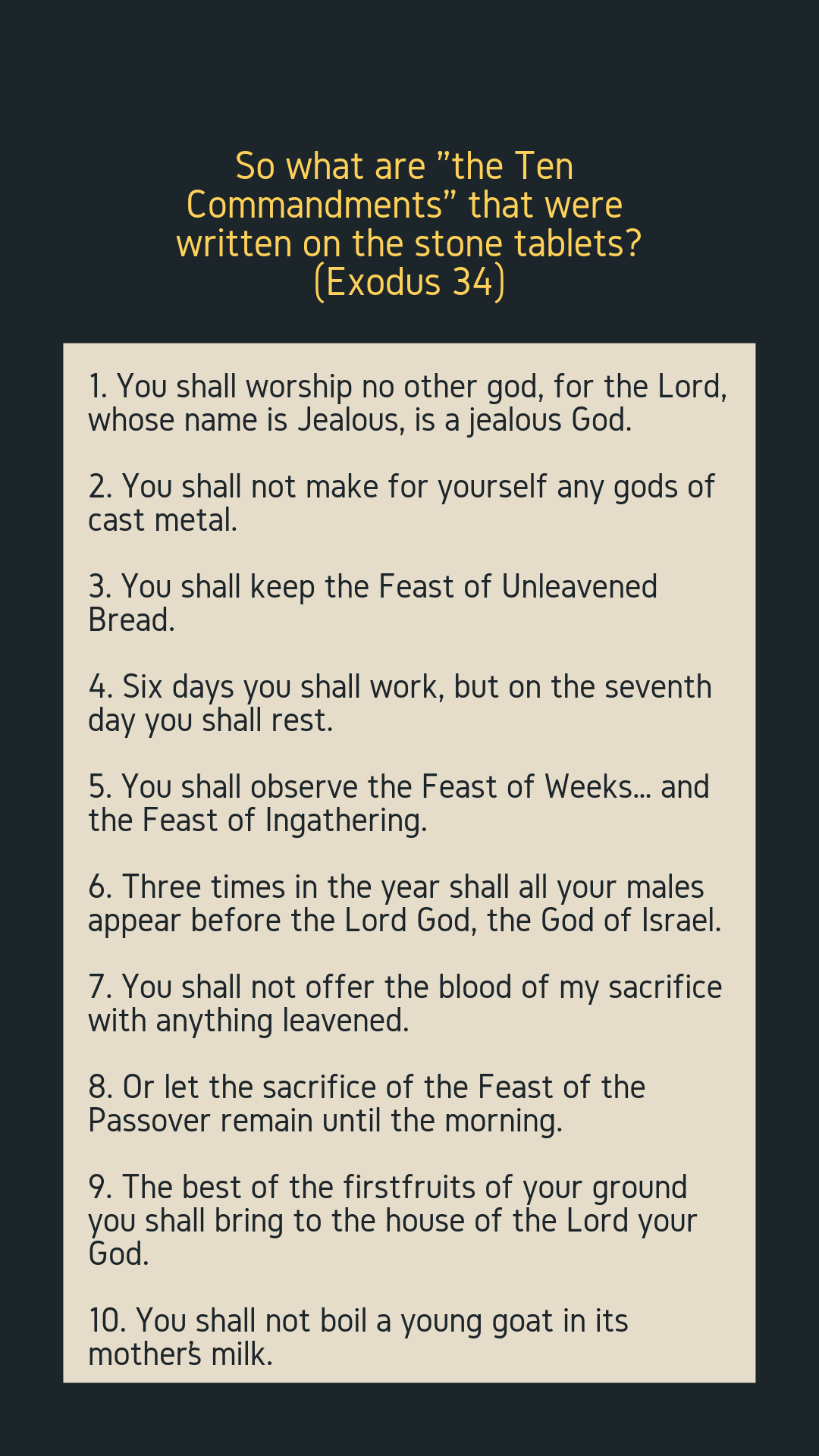
So what are “the Ten Commandments” written on the stone tablets?
- “You shall worship no other god, for the Lord, whose name is Jealous, is a jealous God.”
- “You shall not make for yourself any gods of cast metal.”
- “You shall keep the Feast of Unleavened Bread.”
- “Six days you shall work, but on the seventh day you shall rest.”
- “You shall observe the Feast of Weeks… and the Feast of Ingathering.”
- “Three times in the year shall all your males appear before the Lord God, the God of Israel.”
- “You shall not offer the blood of my sacrifice with anything leavened.”
- “Or let the sacrifice of the Feast of the Passover remain until the morning.”
- “The best of the firstfruits of your ground you shall bring to the house of the Lord your God.”
- “You shall not boil a young goat in its mother’s milk.”
You don’t have to tell me… but did you really know the answers?
Most people don’t.
Yet most think they know all the basic information about the Bible.
Whats going on?
Two psychologists, Rozenblit and Keil, first coined “the illusion of explanatory depth.”
They said “Most people feel they understand the world with far greater detail, coherence, and depth than they really do.”
This is because human civilization has accumulated a lot of knowledge. Yet, as individuals, we are like babies left alone in a forest. Most of us know so little, we could not survive without civilization.
Adam Waytz, another psychologist, says:
“we have infinite access to information, but consume information in a largely superficial fashion.”
In other words: “We consume knowledge widely, but not deeply.”
Rozenblit & Keil did an experiment where they asked participants to write down their opinions about heated political issues (like single payer healthcare, carbon emissions, etc)
Afterwards they were asked to write out a very detailed explanation about the subject about which they gave their opinion (for example “explain every component of the current healthcare system)
After struggling with the technical details, respondents all changed their opinions to be more moderate and less dogmatic.
What does this mean? Only a fool is confident.
Think about this: You first have to learn some fact, to even realize that you were ignorant of it yesterday!
So the next time feel confident in yourself, take a pause.
“The one who doesn’t know.. doesnt even know that he doesn’t know”
Comments (0)
No comments yet.