Post
How I Learned to Not Drink from a Fire Hydrant
I am pretty sure my generation was the most overinformed generation since the history of the universe. Not to mention that most of what we were promised turned out to be little more than hype. In the 80’s we were told we could grow up become anything we wanted. In the 90’s, we were promised flying cars. In the early 2000’s, the collapse of the world economy, followed by the Rapture. And yet, here I sit, un-raptured, on the ground, and definitely not an astronaut (NASA if you’re reading this, please hire me).
And that was only the beginning. Today we are seeing the amount of information (both accurate and bunk) increase exponentially. This growth has not gone unnoticed. And so, in an ode to the irony of it all, there are now mountains of articles lamenting that the data overload from social media and the internet is making us zombies. These cries are not new, technophobes have been warning us about the dangers of information overload since the advent of the printing press, and for most of history we have been right to wave them off.
“We have reason to fear that the multitude of books which grows every day in a prodigious fashion will make the following centuries fall into a state as barbarous as that of the centuries that followed the fall of the Roman Empire. -Adrien Baillet, French Scholar, 1685I'm not so sure anymore. I believe we have entered a dangerous time in human history.
1. What is Information Overload ?
a. Data is not the same thing as information
I dont want to cry wolf by shouting things like: "90% of the data in the world today has been created in the last two years" (well duh, because billions of people now own 1000 gigapixel camera phones and cant stop taking pictures of their freaking avocado toast). I'm not bothered by sheer data in megabytes, or the amount of videos you can store to your YouTube account.It’s easy to classify information overload as question of hard disk useage in bytes. And its true that the amount of computer data that is collected and stored has increased exponentially, but there are many reasons for this that don’t have to do with an increase of information.
A computer may need a thousand pages of “data” to reconstruct a video, but it only eats up 10 seconds of human attention. Inversely, a scientific article may only be 5 pages of “data” but this data can take the average human an hour to understand.
A 6 minute video clip of Drake in concert is roughly 3,600 megabytes of “data,” while the 60 hour long reading experience of ‘Harry Potter’ can be saved to a data file that is only 10 megabytes.
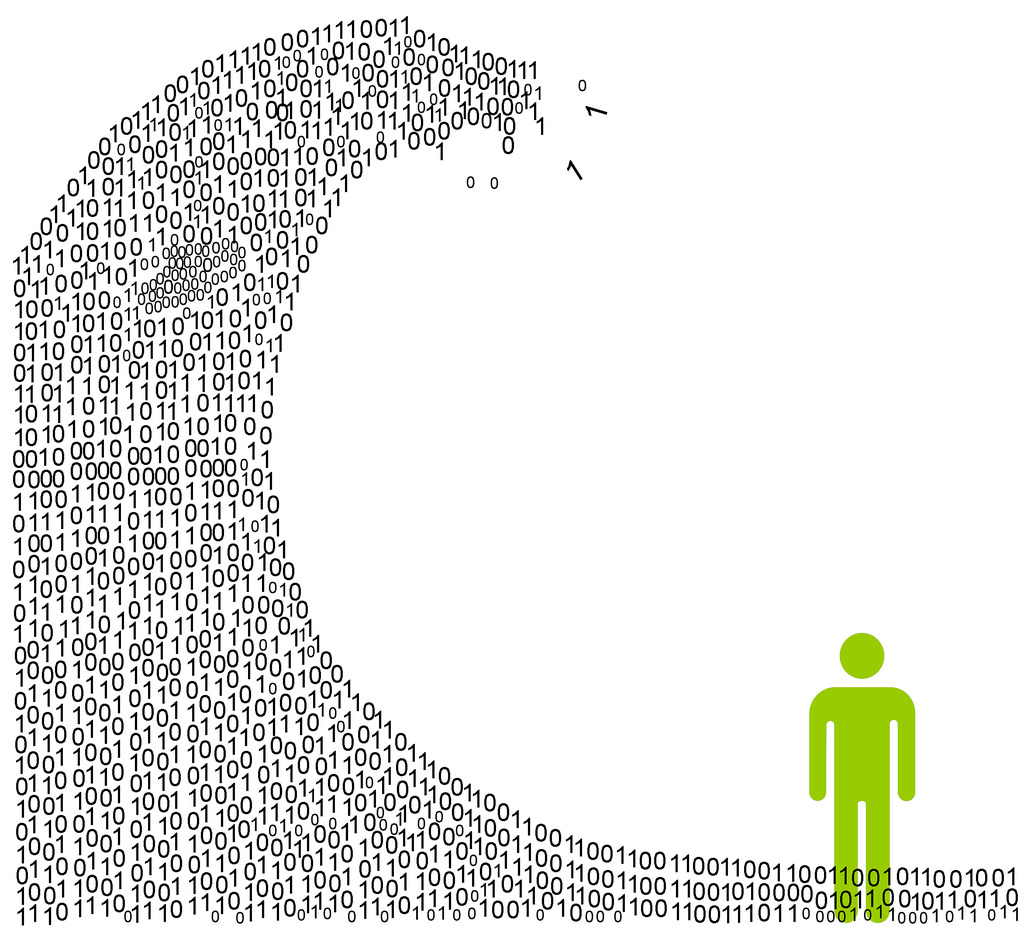
Data is not the same thing as information.So lets step aside the question of 'data' as storage space on a hard disk, and instead speak of information as a sequence of ideas, concepts, or descriptions that are understood by the human mind. We can call this anthropocentric information (as opposed to computer-interpreted 1's and 0's). It is here that the problem arises. For most of history, homo sapiens have had a small stream of information vying for our attention. But modern information technology combined with the rapid growth of human population is creating a raging torrent of comprehensible information on a scale never seen before. It is exploding so fast that we are in danger of becoming more stressed out, less productive, and worse decision makers.
b. The anatomy of an information explosion
As with other apocalyptic warnings, there are four horsemen in our impending informageddon: Creation, Accumulation, Dissemination, and Automation. These are the four steps that produce the rapid availability of information to levels that vastly outpace thousands of human life spans.i. Creation
- First, spoken language enables humans to create information that can be shared with others.
- As population grows, the number of information creators increases. First this increase is slow and steady, and human population wavers below a quarter billion for most of human history. In the mid 19th century it reaches a billion. Today, its reaching 8 billion.
- As people live longer, the intelligence and thus information-generating-ability of this population also increases. In addition we spend less time focused on basic survival needs, and become more literate/educated and productive.
ii. Accumulation
- The invention of the alphabet changes everything. Literally. While humans could previously generate information by speech, they could only store fragments in memory. Written language allows one person to produce a cumulative 50 years worth of information, and share all of it.
- Each successive human adds more information this cumulative record. There is a snowball effect: as the snowball rolls down the hill, it absorbs each new layer while still keeping the old, so that anyone in its path must deal with not only the most recent layer of snow, but also all previous ones combined.
- A child growing up in the 80's had 25 foundational Disney films as a starting point for their foray into pop culture, a child today has 113. Cinderella isn't replaced, she is joined by Belle, Ariel, Simba, Buzz, McQueen, Elsa, & Moana.
iii. Dissemination
- Before the printing press, archived information was very expensive to spread. In ancient France, it cost 1 florin for a scribe to copy a book. With the press, for the same price, you could print 341 copies!
- With the advent of the internet, and many free services, the cost has gone down even more. There are billions of webpages and documents hosted on free channels. Information is now free.
- The format and amount of channels that enable fast and cheap dissemination of information has also exploded. Print, radio, video, ebook, blog, 3d animation, mobile apps, interactive data visualization, games, virtual/augmented reality, etc.
iv. Automation
- Full automation is the equivalent of dumping an ocean of gasoline onto an out of control forest fire. For now, we are only doing the equivalent of scooping it out with a coffee mug but more is coming.
- Currently automation is used to disseminate information cheaper and faster, in many cases actually reducing available information by only targeting certain users with certain content (like facebook ads).
- We are beginning to play with procedurally generated content. For instance, some music is generated by AI, or video game worlds are populated by procedural generation (instead of by human artists drawing each detail).
- The Washington Post is experimenting with AI algorithms that write news articles
- It takes 20 years to grow/train a human capable of writing news articles, and 1 hour for her to write the average article. Eventually AI algorithms will be "trained" in minutes, and will generate thousands of articles by the time a human has written just one. And because of the magic that is copy/paste, AI reporters can be multiplied to (almost) infinity.
- If automated processes can create, archive, and disseminate information without manual intervention, this can lead to another source of exponential informational growth. Granted, for now, these algorithms, while impressive, are no match for humans. But this can change. Will change.
c. What kind of information is increasing?
Here is a sobering fact:There will be more information generated in the next ten minutes, than you could digest in your lifetime.And its not just information, its meta-information (or information about information). So not only must you count the amount of time it would take to read a thousand books, but the information about those books (the reviews, GoodReads comments, rebuttals, the prices at various stores, different editions/formats, etc) which generate a heavy meta-informational burden, making it incredibly difficult to simply pick one to read.
Even mundane decisions, like baking some cookies, can become burdened by meta-informational smog. Would you like to bake some cookies? Just type in “cookie recipe” into Google. Oh jeez, there are 6,080,000 results. Lets just use a random recipe website. 5,095 options here. That doesnt sound too bad, right? Oh, wait, thats a new cookie recipe every day for 14 years. Perhaps you should just buy a cookbook, those are only a few hundred pages, can’t be too crammed, right? Lets just head over to Amazon and search “cookbook.” Gulp. “Over 60,000 books found.” Arg@#$@$!! Screw this, you should just buy some! Oh. Amazon has over 10,000 cookie results in their Grocery section.
Let me illustrate this by telling you the history of books in the U.K.
First, lets look at the normalized rate of publication, that is how many books are published for every million people.
And its not just books. Consider a few other types of information that our modern human brains are bombarded with.
i. Pragmatic Knowledge
- The average human is required to remember hundreds of accounts, passwords, addresses, websites and etc. As well as the knowledge to navigate the complex legal, medical, social systems, each with hundreds of components, modules, and ideas. For instance, would you like to go see a doctor? You need set up health insurance, figure out your deductible/copay, research which of the dozen clinics in your area takes your insurance, parse through review sites to find a good doctor, fill out a dozen forms which use hundreds of medical terms, navigate to the pharmacy, research the medication to ensure there are no contraindications, and etc. Contrast that to medicine in the 17th century: you have one doctor in your village, he comes to your home, and physically gives you a pill. Well, you probably die anyway, but it was simple.
- Todays children must go through an average of 12 years of schooling, whereas for most of history only a few elites had access to education.
- A hunter-gatherer child had a handful of vocational options. Today, the average teenage gets to choose from 7,018 different occupations listed by the ISCO.
- Are you trying to learn programming? There are hundreds of different languages, many of which have dozens of unique frameworks, and for the more popular ones, hundreds of thousands(!!) of modules and libraries. It would seriously take a thousand lifetimes to learn them all.
- Someone trying to catch up on the latest scientific research, per Microsoft Academic a portal for academic articles, would have to parse through 173,919,096 publications (as of May 2018.)
- PubMed, a free database of healthcare journal articles has nearly 30 million publications. Each day, about 2,400 new publications are added to this database. Given that the average time to read a journal article is now 32 minutes (down from 48 minutes in the 1970's), each day you have 1,280 hours of new medical research to read.
ii. Social
- A modern human can digest information from hundreds of people on any given day. With platforms like Instagram or Netflix, he can see thousands of faces in a day. Contrast that to the fact that most ancient humans never met a thousand people in their life as most lived in small tribes of less than 150 (see Dunbars Number)
- We are members of more groups today than ever before. Nation, political party, state, city, alumni, church, family, work, club, gym, sports team, video gaming guilds, and more. It's so complicated that many of these relationships are managed by software (i.e. Facebook groups, bulletin boards, websites, calendar apps, email distribution lists, and those pesky group messages where 80% of people never reply.)
- There are more communication formats, platforms, and channels than ever before. You can interact with people via tens of thousands of text based platforms like instant messaging apps, email, forums, social media, audio or video messaging, cooperative video games, and VR/AR. Hell, you can use Microsoft Word to carry on a conversation using the comments feature.
- In addition, the speed at which culture is changing means language itself is evolving faster than ever before. There are over 5000 new words invented every year, 1000 of which become commonly used. There are emojis, acronyms, viral phenomena, cultural slang that is evolving and becoming extinct before our eyes.
iii. Sexual
- An adolescent living in the age of high speed internet can see more nude women in one porn browsing session than one could encounter in the ancient worlds largest brothel or harem. Every single kind of sexual fantasy, kink, or niche is represented.
- Sexual fantasy is a part hundreds of thousands books, television, shows, video games, posters, and advertisements. The average human is bombarded with hundreds, if not thousands of sexually suggestive visuals every day.
- Humans go from having a small handful of potential mates in their tribe to a world with explosive population growth that allows interracial marriage. Not only are modern humans given something usually unheard of, the choice of a spouse, but they also have applications like Tinder or Facebook where they can swipe past tens of thousands of possible options. The data about all of these options is also available, you can gather information about each potential mate spending dozens of hours on Facebook, LinkedIn, Tumbler, Instagram and etc.
iv. Advertising
- We live in a world where tens of thousands of brands are in frenzied competition for our time and attention.
- You see between 13,0000 to 30,000 television ads every year.
- Once you include every form of advertisement, including web, print, and branding, it gets worse. It's estimated thay we see 3,000 advertisements per day!
- The variety of consumer products available is greater than at any other time in history. Would you like to buy a simple leather wallet? There are thousands of options available online.
- Each year there are thousands of new inventions, gadgets, and gizmos being introduced into the collective human imagination. And while there is "convergence" (your iPhone can do the work of a camera, audio recorder, portable television, telephone, book reader, and calendar) the reality is that there is more divergence because of market forces. So while you don't need a seperate portable television or audio recorder, there are now 2.2 million apps, 50,000 cases, and 10,000 car mounts, and 2,000 portable chargers, and 1,000 lens extensions available for your iPhone.
v. Entertainment
- Even though we are constantly saying "there is nothing to watch on TV/Netflix" the IMDB containts 4,734,693 titles, of which over 3 million are TV episodes and half a million are feature films. The average western human can hope to live to 80, which translates to 700,000 hours, roughtly the same time to watch those 580,000 films - if you don't sleep, work, eat or watch TV (because the TV episodes will take up about 3 lifetimes)
- There are between 30 to 40 million songs available to stream on platforms like Spotify. That is roughly 225 years of music. And every day, around 41 days of new music is uploaded to Spotify, so you will never catch up.
- There are over 32 video game systems, one of the largest platforms, Steam, had 7,241 titles added to its library in 2017, bringing the total up to 21,757. If you got hired for a new full time job that involved playing the titles from this one platfom, and using a conservative estimate of 10 hours per game, you would have a "career" of 105 years of gaming.
- There are over 1.87 billion websites on the internet, so if you wanted to visit each one for 10 seconds, it would take you 600 years of non stop clicking (carpal tunnel anyone?)
- Streaming sites like youtube have brought on an even larger expansion of content. There are 300 hours of video uploaded to YouTube every minute!
2. Problems resulting from IO
Compiling the information above gave me a headache. And that is precisely the reason "information overload" is dangerous. When human civilization first began the transition from darkness to the information age, we did it with the belief that more information is always better. After all, knowledge has always led to better decisions, helpful inventions, and better outcomes, so more information should have led us to more positive outcomes, right? Instead, our fate changed from chapped lips at the mercy of a dry faucet, to bruises from a high pressure fire hose. The raging deluge of information has led to a cacophony of fractured voices and frantic decisions. There are so many voices out there that half of us don't knows what is right anymore. Even worse, the other half think they are Einstein. All of us are frantically scrolling, tapping, swiping, and sharing; trying to stay afloat, to not be left behind as the tide of information keeps rising.This age of information has not brought us salvation. Instead of contentment, we see anxiety, an obsessive cycle of angst and addiction. Before we have finished reading the first sentence, our thoughts are invaded by the fear of missing out on something else. And we are flung into an aimless journey, wandering in the desert like the Israelites, chasing the ultimate promised hyperlink.Of course, not all is bad, there has been so much progress for human well-being in the last few centuries. I am connected to hundreds of people from the safety of my home, I have refrigerated fruit in winter, and there is a 4k television besides me, ready to delight my senses. These are all things made possible by information. Good, accurate information is a good thing. But too much of it at once is something our frail minds simply can't handle. Here are some of the pragmatic downsides:
a. It hurts our brains
- We live in constant frenzy, causing an increase of the stress hormone cortisol which in turn will" overstimulate your brain and cause mental fog or scrambled thinking."
- Every decision you make eats up glucose in your brain. Thus deciding what to do with the notifications on your mobile device actually uses up "brain fuel" leaving you with mental fatigue.
- By switching from a small number of data sources to thousands, we are forced to ration out our attention span, giving little bursts to each source of information. This in turn wires us to have a very short attention span, and we are unable to acquire "deep knowledge" which requires prolonged concentration.
- Constantly juggling between information sources takes up so much mental energy that we end up learning far less than we could by simply paying attention to only one thing. This is called Continuous Partial Attention (CPA). I have caught myself listening to podcasts and scrolling through news/social feeds to try to "hack" my learning. After a while I then realized that not only was I was not engaging fully in either, in the end I had no idea what the hell I listened to or scrolled past.
b. It impedes our actions
- The time to make a (good) decision increases as we are plagued by "choice paralysis" or "Overchoice". We can spend hours sitting on Amazon to find the perfect phone case, scrolling past hundreds of cases, trying to find "the perfect one."
- Our long term thinking and planning begins to suffer. There is so much information coming into our brains, that we can barely focus on the next ten minutes and don't have the energy to plan.
- We begin to operate with a pseudo-ADHD, constantly starting new books, projects, or television shows, which are quickly forgotten as we jump to the next thing, and the next one after that.
- Our ability to "reflect, to make decisions, and to think creatively" is damaged as we are constantly in "crisis management" mode, trying to stay afloat of the flood of information quickly rising around our necks.
c. It burdens our society
- Corporate behemoths are investing tons of their energy into grabbing your attention, regardless of the social or environmental cost.
- Society at large, having tasted the dopamine rush of new information, is becoming more concerned about novelty instead of accuracy or utility. Nerdy scientific breakthrough? Boring. A puppy riding a tricycle!? Share!!
- The large influx of information into arenas with no gatekeepers has created mountains of shit information. There are thousands of hours of youtube videos "proving" a flat earth. Good information becomes increasingly difficult to find.
- In some cases, the multiplicity of information is causing a form of relativism as people begin to assume "all information is equal."
- Everyone is stressed out, impatient, and angry. You can't drive down the highway without seeing people staring into their phones for their fix. Or else they are angrily tailgating you, eyes red from information overload, veins throbbing with cortisol. Okay, okay, maybe its not that bad. but it definitely increases societal stress.
3. How to solve Information Overload
For the past decade I have never commuted to work without lectures, audiobooks, or podcasts blasting in my ears. I am too afraid of missing out. There is so much to learn and so little time! First it started with speeding up the current podcast by 50%. Then I would concurrently skim some articles or my Reddit feed. Then I'd find myself with work on one one screen, a lecture on the other, and a giga-zillion chrome tabs in the background.Six months ago, I first realized that this wasnt working. More data was passing through my brain, but less of it was doing good. It was too much.
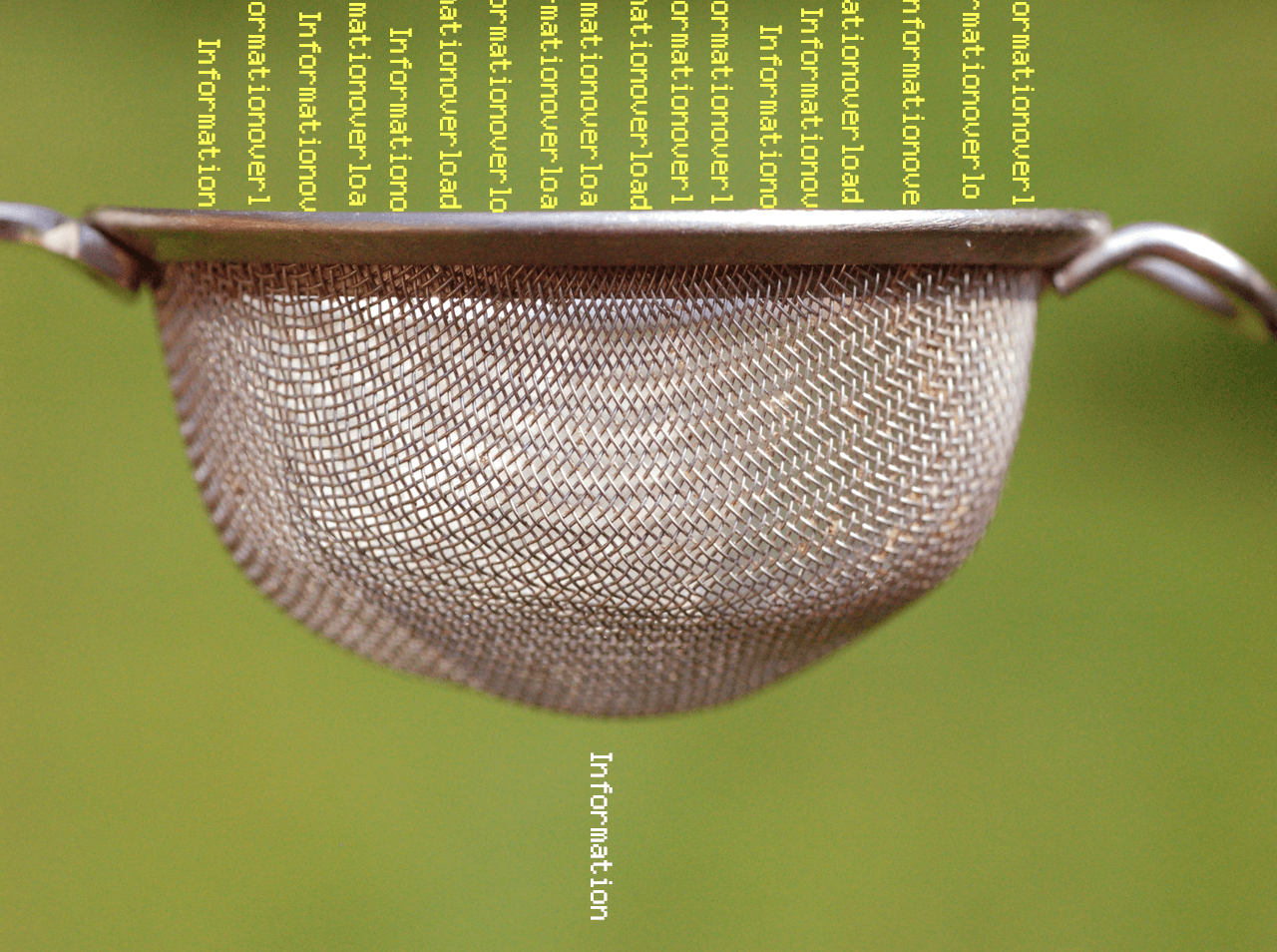
I became information rich, but attention poor.Over the next few months I began the journey of learning about information overload, and minimalizing my informational life. What follows is not the usual bullshit advise, but real steps that I've taken, or am working on (after all, addiction is not easy).
3.1 Stop trying to chase relevance
- Its impossible to learn the skills you want, read the books on your list, or stay current. It would take 10,000 lifetimes, but you only have one. Setting impossible goals will only lead to stress.
- Understand that the reality is, the majority of information at our disposal is a cacophony of mediocrity. Most of it is rubbish. Verbose ramblings from people who should be slapped with a restraining order for their keyboard. It's okay to skip it. And you know what? Some of my writing qualifies.
3.2 Give up trying to remember everything
- Juggling too many ideas and tasks in your mind leads to a cesspool of confusion. Write down anything that is important in a journal.
- It doesnt matter what format you are using (I have a Rhodiarama Dot Journal and use Google Keep/Docs heavily). The important thing is to actually use it.
3.3 Reduce the amount of incoming noise
- It was predicted in 1997, that we would become an attention economy. Today everyone wants you attention so they can build their brand and sell you stuff. Nothing is free, trust me. Hell, I'm doing this so you'll like me and buy me coffee.
- Disable any incoming services that interrupt you with notifications.
- Unsubscribe from all those spam emails. C'mon. You have Google. If you want to look at it, it's two clicks away.
- Turn off any non-essential notifications on your phone. Seriously, is it really that important to get notified when Katie posts a picture of a fucking avocado toast? Seriously?
- I am not against social media, I am against social media dictating when you to look at it and for how long, rather than it being your premeditated decision.
3.4 Reduce the amount of tasks you do at once
- Multi-tasking does not work. In fact it "damages your brain and career". What it does is give you the illusion of hyper-productivity, which is really just stress and cortisol. Multitasking is the equivalent of the drunk driver who says "its finnnee, i ken dryve" but can barely walk.
- Stop using millions of tabs. Oh, God this is difficult, it was my problem for the longest time. I have been using a Chrome extension called OneTab, which saves all open tabs for later reference. You have too many open? Click the OneTab button, they get saved, and you have a clean slate.
3.5 Only start what you want to finish.
- Your attention is the most valuable commodity you have. Because attention is just another word for your time, its the only thing in your life you can't make more of. Be stingy. Or else you'll be constantly starting new books, and never finishing any.
- Again, remind yourself that you can't do, read, or learn everything. You are finite, information is probably infinite. You need to decide what things are worth giving your attention to, because you can't give it to everything.
- You are surrounded by billions of dollars of marketing, most of it peddling crap. If you let the wind take you, it will take you in circles, and you will end up nowhere. You hate to be very intentional about where you steer your mind and focus.
3.6 Learn to surrender
- Back when I was a preacher, this would be where I make the overly sentimental closing statement. Something particularly poignant like the only way to win, is to lose. And maybe, just maybe, this post deserves exactly this kind of ending. The practical reality is, you are outgunned, outpaced, and outnumbered. The magnanomous horde of information is at the gates, and if you try to fight, you will lose. The only option left is to surrender the fight. Accept defeat. Accept that you will never be able to stay "current." Accept that all your frantic scrolling, scanning, and searching will still fail to keep you on top. And thats okay, after all, were only human.
Comments (2)