Post
Is The Fire Dying Out? - Why Young People are Less Zealous About Religion
A few weeks ago I was in a discussion about the current state of Christianity in my community, and we began to compare our own youthful zeal to the current landscape. After much thinking and research, we were unable to find teenagers/young adults that were as fervent as us in our younger years.
This prompted me to do a quick poll of my social network, asking::
Sometimes it feels like my generation was more zealous about their faith.Is this really happening? Or am I seeing it because all the zealous Christians have unfriended me and I’m stuck in a feedback loop of like-minded peers? Maybe it’s because I am projecting my own general apathy towards religion into the minds of others? Or perhaps this represents an overall change in social media use? Maybe it could be something to do with brain science of nostalgia and the reminiscence bump? Or perhaps I’ve become so old that I have resorted to becoming another manifestation of the “in my day” meme?Does anyone else get that vibe?
We were so passionate, that our faith was the dominant thing in our life. It was prevalent in all aspects of our life. On social media, it led to us writing blogs, hosting public conversations, in practice it led us starting various outreach projects and etc. All of our hangouts were focused on discussions about the Gospel and so forth.
In our days, there seemed to be no division between sacred and mundane, it was all sacred. Today, it seems as though the new generation is only sacred… well, in church.
In looking at the younger church kids, it seems there isn’t anybody with that passionate fire that we had. Nobody from the younger generation is engaged in public dialogues about how to live the Christian life, like we did. They just post photos of toast and hikes. Neat, but mundane. I don’t see any new passionate leaders rising up in the Russian community. There are just a few leftovers from my generation holding the torch, but even they seem to have diverted their efforts to raising children, flipping real estate, or running businesses.
Anyone else see that?

All these things are plausible explanations, and perhaps even involved to some degree, but I don’t think they can fully explain my direct observations and conversations. I’ve spoken to Christian friends, many of whom echoed the sentiment, some even admitting that in their own lives they’ve stopped “having as much time” for faith.
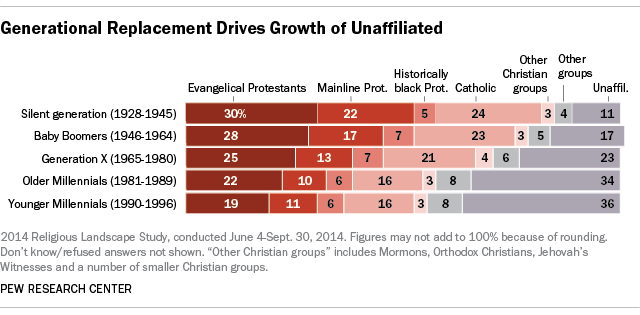
So I did the crude and very unscientific poll above. About 70% of a hundred or so respondents, most of whom were still within the church, responded with a yes to the poll: the fire is dying out. About a dozen more messaged me privately, some enthusiastic, others wholly disheartened that this is something they too had been paying attention to. Compared to the dozen, four messaged me with great enthusiasm, testifying that things are as fiery as ever. But besides my own personal experiences, there is data (!). And the data shows that young people are less involved in religion. (1, 2, 3)
So the question is why?
Why is the fire dying?
As I see it, there are a number of conditions that created the swell of religious passion during my youth. I can't offer undeniable empirical proof that these are exhaustive but I believe the case is robust.1. Reason is not winning this game
Some of my secular friends may be inclined to view this as some kind of positive message regarding the rise of what they see contrasting religion: education, careful rationality, and critical thinking. Alas, I don't think this is the case. I have given up believing that humans are wholly rational creatures that can change the course of history by reason.The psychologist Jonathan Haidt, writing in The Happiness Hypothesis, uses a poignant metaphor to explain how we first act and later rationalize. This is the story of the elephant and rider.
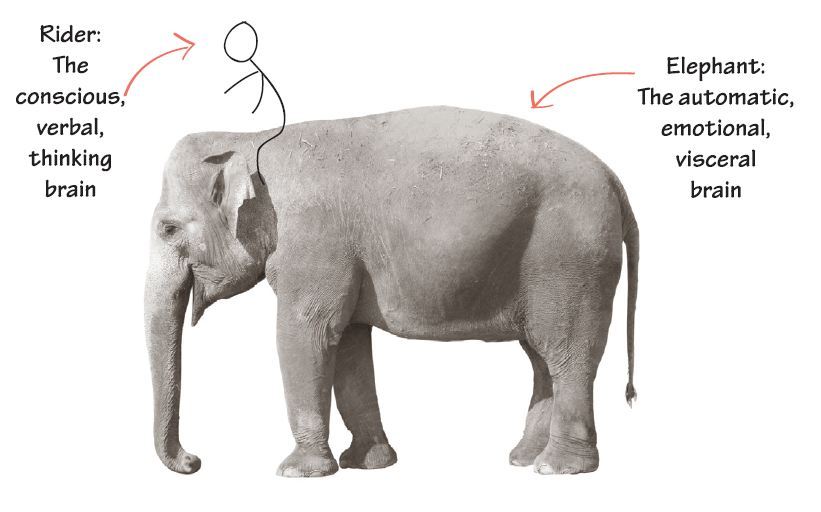
The elephant represents all of our automatic, or subconscious processes and proclivities. The elephant slowly lumbers ahead, moving by its own volition. The rider represents the intentional part of our rationality and consciousness. The rider may attempt to tug, push, or pull on the elephant but cannot move it by his own force. He can only attempt to train it, in hopes that it would change direction on command. Yet, ultimately the elephant moves as it pleases, and the rider is often a passive observer of the procession. Ironically enough, the rider still feels as though he is fully in control and will create an explanation that puts him in charge of every change in direction.. after it takes place.
Ultimately, I believe the cultural elephant has shifted, but it is not because the rider has become more rational or analytical.
2. We grew up at the edge of the apocalypse
So why were we more zealous about our faith? What caused the elephant of my youth to drag me towards night long prayers? What pulled my generation to be so hungry for the Christian Gospel?Because we grew up at the precipice of eternity.

We ate our cereal at the midnight hour. We brushed our teeth, knowing the rapture was imminent, as the last push of the church - spearheaded by us - would usher in the apocalypse. I have personally received a prophetic word that I would be a pastor, raising people from the dead, in the next few years and then the end would come. I was 13 at the time.
But our prophecies too came from forces outside our control, and not the ones you are thinking. I believe it all began in the time leading up to the turn of the millenium. It started with the dot-com bubble, where many people lost their sense of stability. It continued through stories of Y2K computer crashes that could wind back civilization hundreds of years, and was seasoned with threats of terrorism after the horrific September 11 attacks. Our lives were saturated with new millenial fears of incomprehensible technologies creating an alien world, as new gadgets wiped away whole industries, replacing hundred year old traditions with new foreign concepts. And all this ended with the largest housing bubble in history that savagely ripped away any last belief in the stability of our generation.
It was the turbulence of our times that made us erupt with religious fervor. In our eyes, all of these signs validated that we were in the “days of Elijah, preparing the way of the Lord.”
3. Our children have comfortable beds
So what's different today? Why are the flames of religion slowly cooling, especially among many of the young? (4, 5)As strange as this is, I believe one of the reasons is that we are experiencing the longest bull run in US stock market history. People are making money. Stocks are up. Stability is up. Real estate is up. Business is up. Job growth is up. Everyone and their mom is flipping houses, and making a killing at it. Heck, even the millennials who constantly complain about poverty, don’t think the economy is doing bad overall, but only that they aren’t getting a fair piece of the pie. The pie is there, it’s big, but the overweight boomers are hogging too many spots at the table.
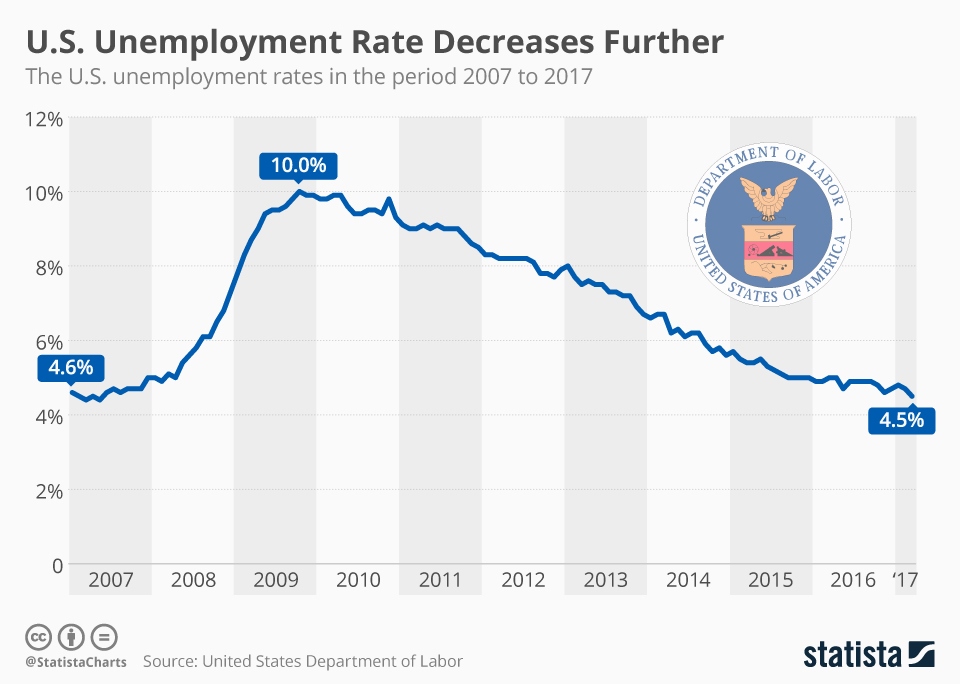
What does this have to do with religiosity? Often times, the rates of church attendance and religiosity can be correlated to financial stability. Its quite plausible that when people feel financially stable, they don’t have time or mind-space for God. During many previous recessions Evangelical church pews were brimming, even as mainline churches continued their steady decline. (6, 7)
What’s even more striking is that we can predict how religious a particular region is by reviewing its socioeconomic living conditions. Regions with increased famine, war, disease, poverty tend to be more religious. On the other hand, nations with better living conditions, are usually less religious. Note that this is a correlation, and not necessarily causative, but there is a very strong logical explanation: people who are needy turn to external sources of help.
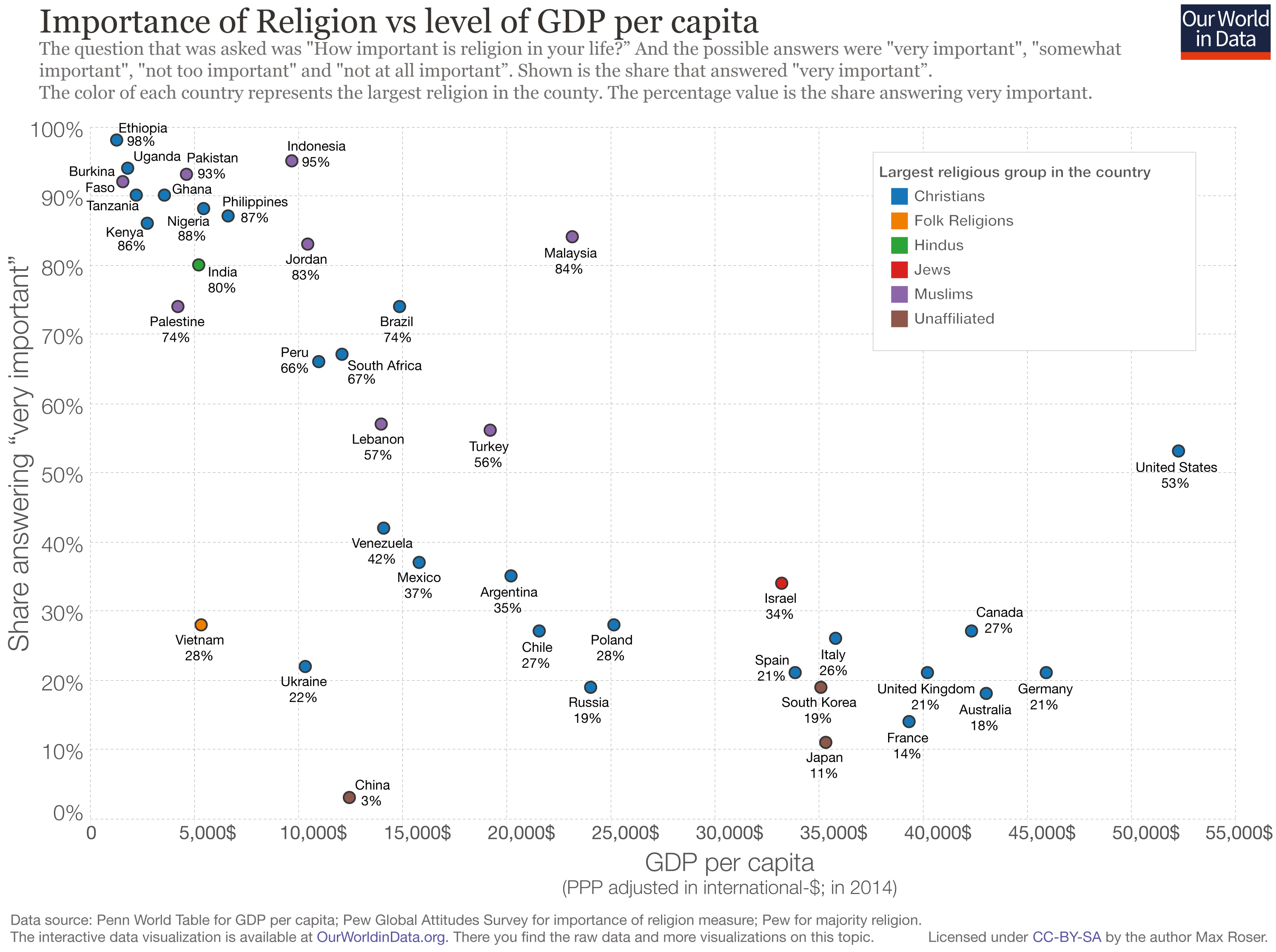
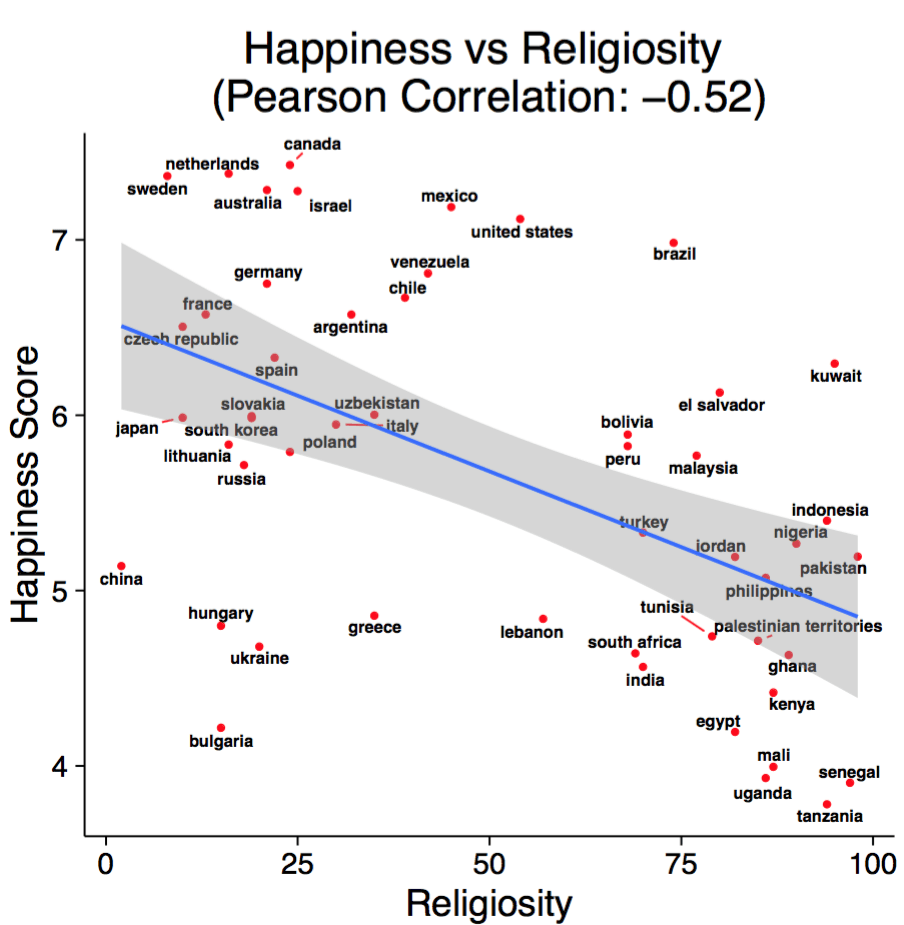
So is the increased financial and overall well being leading the evangelical fires to slowly burn out? I believe this is one of the key factors (even while there are other reasons that play a role, including anxiety as a response to novelty.)
4. We've all gotten used to the new climate
Humans are anxiety machines that fear change. Think back to any time you were put into a new situation and you how you responded. Likely you became nervous until you acclimated. If you watch children as they are thrust into a completely unfamiliar room with strangers, you will see that most respond with separation anxiety and often with tears. In the same way, but on a much wider level, our whole generation was catapulted into an unfamiliar room: the birth of the digital era.Most social and technological change occurs in waves. First you will see the peak of the wave appear from beneath the surface, then the wave simply continues getting larger and expanding. With technological revolutions, first you see the introduction of some radical new device or idea (for example, the original iPhone).

Then, over the next decade or two, the wave slowly continues getting larger, the original model sees iterative improvements (iPhone 2,3,4,5,6,7,8,X, etc). These are not as revolutionary, but mere improvements and refinements of the original earth-shattering product. And on and on.
We lived to experience the birth of the digital age, and the uncertainty of the brave new world it promised to bring. We were thrust into a new room and reacted with anxiety. But then we looked around for a while, got used to our surroundings and it wasn’t so new anymore. Today, we are only seeing subtle improvements and refinements to the technologies that erupted out of nowhere and redefined our culture. Certainly more upheavals are coming, but they are just beyond the horizon.
5. We ushered in the kingdom, but it was just Benny Hinn in a Hillary Clinton suit, looking for donations.
Finally, I think the last reason evangelical zeal has cooled is because we tried. We really freaking tried. I remember youthful preachers, filled with tantalizing energy proclaiming that we were the final generation. I remember seeing the glossy eyes of my peers. Our hands raised up in prayer, chests bursting with authentic faith. We were ready to evangelize every corner of the world and to lay down our lives for it. And dear God we tried.But reality had different plans.
Reality showed us bold men and women, full of glorious promises, who were repeatedly removed from office due to sexual or financial scandals.
Reality showed us the Benny Hinns of the world, taking bus money from a senile grandmother, so they can fuel their private jets, to fly to a crusade where they would ask for even more donations.

Reality showed us churches being fragmented by pastors and attempted-pastors, each vying for a prestigious place at the front of the crowd.
Reality showed us that the rapture we awaited didn’t come. The great earthquake never happened. The Israel/Arab war never happened. The third great awakening never happened. The great judgement starting from Slavic churches never happened. The grand miracle revival never happened. The great Exodus to the desert never happened. The European Union did not grow to swallow the world as the New World Order. The many 666 chip aws never came to pass. All these mythical tales, tales that I genuinely believed came and went. Stories were told and forgotten. Large crowds got together to name it, claim it, only to replace it and forget it. Each story, prediction, and prophecy slowly chipping away at the tree trunk that was the faith and zeal of my generation.
And so here we are today, the flame is dying. But rest assured, history repeats itself. There will probably be another revival - but not because of supernatural forces. Eventually those of us who lived through all these failed tales will be forgotten. There will be another massive wave of social change and economic instability. Perhaps it will be war or some new epidemic. Perhaps the Artificial Intelligence displacement of many jobs. Perhaps some new technology we can’t imagine. And this will produce a new generation of glossy eyed teenagers, filled with zeal and passion, who will take up the mantle, genuinely believing that they are the chosen generation.
Comments (8)