Post
Why I dont trust the Bible - Clearly human writing history.
This is part 4 of a series (see part 1, part 2, part 3, part 4, part 5).
The unfortunate reality is that a large number of Christians are not biblically literate. I frequently encourage, and even push, Christians into reading the Bible, cover to cover, because whatever your stance is, its important to know whats in this book that is often seen as the cornerstone of Western Civilization. However, besides knowing what is in the Bible, an even larger amount of people don’t know how it got into their Bible; arguably the vast majority of believers don’t really know how the Bible came to be. If you ask your friend or family member, “where did the Bible come from?” their answer would be something like “God inspired it, people wrote it down, and we have a translation.”
This is ostensibly not the case.
This is like telling people that the United States was founded when “the Pilgrims came to find religious freedom, had a wonderful Thanksgiving dinner with the Indians, and from that, they made a wonderful nation!” Someone who has such a view of American history and relations with the Native Americans should not be allowed to teach history. Yet, Christians who know the equivalent version of biblical studies are frequently found in the pulpit preaching the Bible, implanting these naïve ideas upon young and impressionable minds.
I contend that if you were to fully know the history of the Bible, you would see that it strongly resembles a human book, not a perfect divine revelation.
HOW MOST PEOPLE SEE THE BIBLE
1. God inspired people to write divine revelation, without error; they wrote this down in Greek or Hebrew, put it together in a book called the Bible.
2. This Greek and Hebrew Bible was translated into English, and you have a copy in your hands.
THE REAL STORY OF THE BIBLE
1. We have many different English Bible translations with sizable differences
The American Bible society states that “the number of printed English translations and paraphrases of the Bible, whether complete or not, is about 900.” This includes a whole range of kinds of translations (in simple terms, these are often referred to as “word for word,” “thought-for-thought,” & “paraphrase”). Also included are translations based on significantly different Greek texts, translations that update the Bible with new discoveries of Greek manuscripts, offer a “better” interpretation of certain words or phrases, and those update the Bible to fit modern language. Ask yourself, which of these translation contains the most accurate rendition of Gods words? And if we have one, then why do we need all the others?The reality most people are not aware of, is that there are indeed very significant differences that are often introduced or hidden through translations. For example, there are over a hundred translation differences by the conservative NIV committee that obscure difficult passages and contradictions in the original texts.
- “Every translation involves many decisions by the translator about the Hebrew, Greek, or (in a few cases) Aramaic text. Scholars are still not sure about the meaning for some words, and the biblical languages do not translate precisely into English (or other modern languages.) In addition, we have no original manuscript of any biblical book, and the existing biblical manuscripts disagree with each other at many points.” (An Introduction to the Bible: Sacred Texts and Imperial Contexts By David M. Carr, Colleen M. Conway)
2. These translations come from significantly different ‘Printed Greek Bibles’
Your Bible was not translated directly from the handwritten Greek manuscripts (a manuscript is a piece of papyrus or animal skin with writing on it), but instead your Bible was translated from a modern printed Greek text (an actual book, produced by a printer on modern paper). Before we can translate the Greek New Testament into English, we must first figure out what it is, so scholars first create a Printed Greek Bible. These printed Greek texts are put together by combining and compiling various handwritten manuscript copies of New Testament books, essentially taking tid-bits from hundreds of different handwritten Greek manuscripts and documents, sometimes even merging different sentences from two sources into one.- We do not have one printed Greek text that everyone agrees is “the original Greek Bible,” instead we have dozens of different scholarly reconstructions, each having many differences and updates.
3. These 'Printed Greek Bibles' are compiled from disagreeing families of manuscripts
As scribes made more and more copies, thousands of errors and additions crept into the texts, some of these were accidental, but many were deliberate. For example, the famous story of Jesus and the woman caught in adultery, was a later addition to the text (the earliest manuscripts don't have it) and obviously an intentional one, you cannot accidentally insert a chapter. Because scribes would make a copy of the manuscripts they had in their local region, many of the copies can be grouped into categories or families. These families are groups of texts that were copied in roughly the same time period and geographical location, some examples include the Byzantine, Caesarian, Western, & Alexandrian families.Below is a highly simplified chart of what this looks like, as you can see, doing textual criticism, to figure out what the New Testament should contain, requires thousands of hours of diligent work as well as human ingenuity and skill.
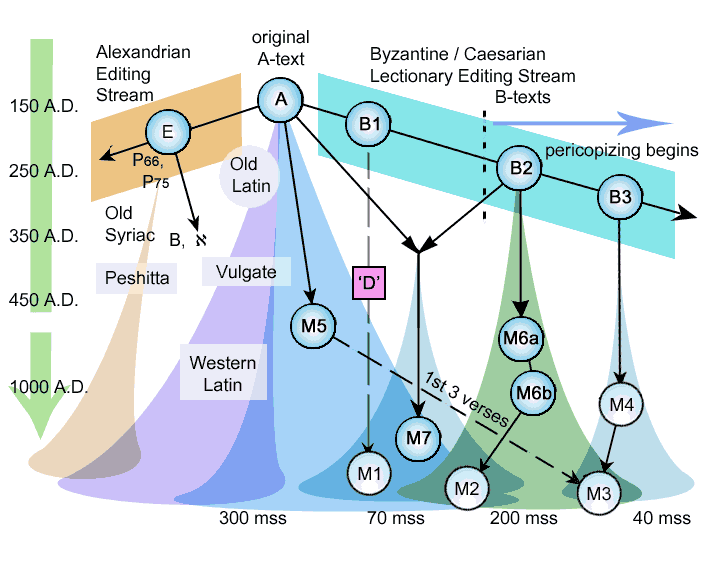 Simplified stemma (geneological chart) of New Testament manuscript families
Today, theologians and scholars select a family tree of handwritten manuscripts and use these texts (not others) to create a Printed Greek Bible, from which they make an English translation. There are various academic arguments for which family is superior, but there is disagreement about which arguments are more persuasive: there are two very different schools of thought on this.
- This literally means there are two very different sets of Greek texts from which modern Bibles are translated. As a result there are two different Greek New Testaments, and various Christian scholars support one or the other is the "real" New Testament. One of these is the KJV/NKJV/WEB family of translations, based on the Byzantine manuscript family, the other is the NIV/NASB/NSRV family of translations, based on the Alexandrian family of manuscripts. Which family is closer to the original? Many scholars make many arguments, and the Alexandrian side seems to have better arguments, but we can't know for sure. (If we did, there would be no disagreement).
4. These families are composed of many disagreeing handwritten manuscripts
At the core of everything are over 5,800 handwritten Greek manuscripts, some of which are nearly whole “bibles," while others are small fragments, just one verse in length. It is very difficult to go through all of these manuscripts, and compare where they agree or disagree, but some of the leading textual scholars have estimated that there are hundreds of thousands of differences! These differences are called “textual variants” and, to be fair, most of them are fairly small. Almost 75% of these are simply misspellings of words, misplacement of words/phrases, however others are far more significant, like the inclusion of a whole new sentence into the text.- The more manuscripts we find, the more differences we likewise find. For example in the 18th century John Mill estimated 30,000 thousand differences, based on 100 manuscripts. About a hundred years ago the great Edward Nestle estimated 200,000. Today the leading textual scholars like Bart Ehrman and even leading Christian textual scholars like Daniel Wallace, estimate up to 400,000 differences in these manuscripts!
In any case, while the vast majority of these are indeed insignificant things, like spelling mistakes, inserting the a different word or a synonym, accidentally missing one word, and etc. many differences are indeed very significant. For example, there is only one verse in the Bible that explicitly teaches the doctrine of the Trinity, and yet this verse is based on a textual variant! (Scholars argue that the manuscripts with this verse are much later copies than those manuscripts missing this verse, but it is the scholars who are left to figure this out out using investigative methodologies and human reason. It is not a supernatural method, but human reason that recreates “the Bible.”
5. Most of these manuscripts are thousand year old copies of original documents that are lost
The original New Testament documents were written in the 1st century (most estimates say between 50CE to 100CE). The earliest fragment of the New Testament is P52, which is an early copy of Johns Gospel, probably only about 30 years after the original! While a lot can of changes can happen in three decades of copying, that is still very early! Alas, it is only 3 verses.Unfortunately we have very few early copies, there are only about six fragments from the 2th century, and only a few hundred that were copied in the first half-millennium. The earliest complete manuscript of the New Testament that we have is the Codex Sinaiticus which was copied sometime during the 4th century, hundreds of years after the originals were written.
Christian apologists frequently argue that we can trust the Bible because there are thousands of manuscript copies of it, and these are a few decades after the originals, unlike some other historical writings, of which there are mere hundreds and dozens manuscript copies. This argument is ultimately dishonest, because it is focused on throwing out a large number to overwhelm the senses. The problem is that the vast majority of those “thousands of manuscripts” they cite are copies made a thousand years after the originals. Most of these thousands of copies are not helpful, because they are copies of copies of copies of copies, vastly removed from the originals. The manuscripts that actually matter the most, are form the first few centuries and represent less than 10% of these “thousands of manuscripts.”
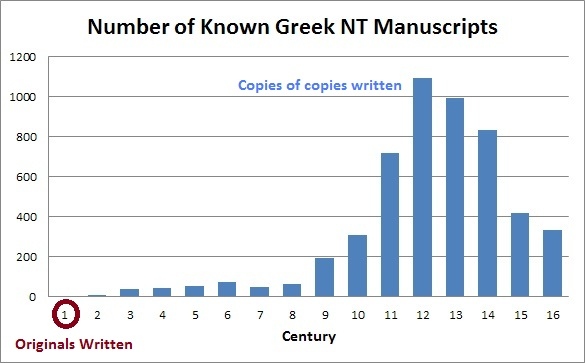
- In any case, the largest problem is this: we simply don’t have the original manuscripts! We have no idea what happened between the original document, the first dozens and hundreds of years of copying. We don’t know if Paul’s secretary wrote down Paul’s words correctly! We don’t know if the first copy that was made of Paul’s letter, from which the other copies came, had an error, edit, or addition. We don’t know and cannot know because all those early documents are missing! Decades and centuries are missing! Its possible there were no errors in the missing decades/centuries, but it’s just as possible that hundreds of radical changes happened. We can’t know without the originals.
6. These handwritten manuscripts came bundled in radically different canons
A biblical canon is a list of books that are considered to be ‘inspired by God.’ While most Christians think that there is only one biblical canon, and this has always been the same, there are actually 10 different cannons in existence today! However, most of their differences are regarding Old Testament books and are pretty minor in comparison to the situation for the first 500 years of Christian history. There were many more canons in the past, and these included very different New Testament books. How do you know which canon is the right one?In the first few hundred years of Church history, there were hundreds of books circulating that were purported to be gospels and epistles of the apostles. Some are obvious fakes and forgeries. Others had a very long tradition of authoritative use in the early church. The first time in human history that a list with all of our current NT books was written was in the late 4th century. In a letter admonishing his churches, Bishop Athanasius wrote a request that his church read these books, including our current books. But he also excluded Esther and added Baruch plus the “Letter of Jeremiah” (different than the book of Jeremiah) to his version of the Old Testament.
- The Codex Sinaiticus, the earliest complete manuscript of the whole Bible, includes the epistle of Barnabas & Shepherd of Hermas right in the middle of the of the New Testament, and excludes many sections of Mark, Matthew, Acts, and so on. The Codex Claromontanus (6th century) excludes Philippians and Hebrews, but includes Barnabas, Shepherd of Hermas, Acts of Peter, and Revelation of Peter.
7. These handwritten manuscripts cite wildly different Hebrew manuscripts
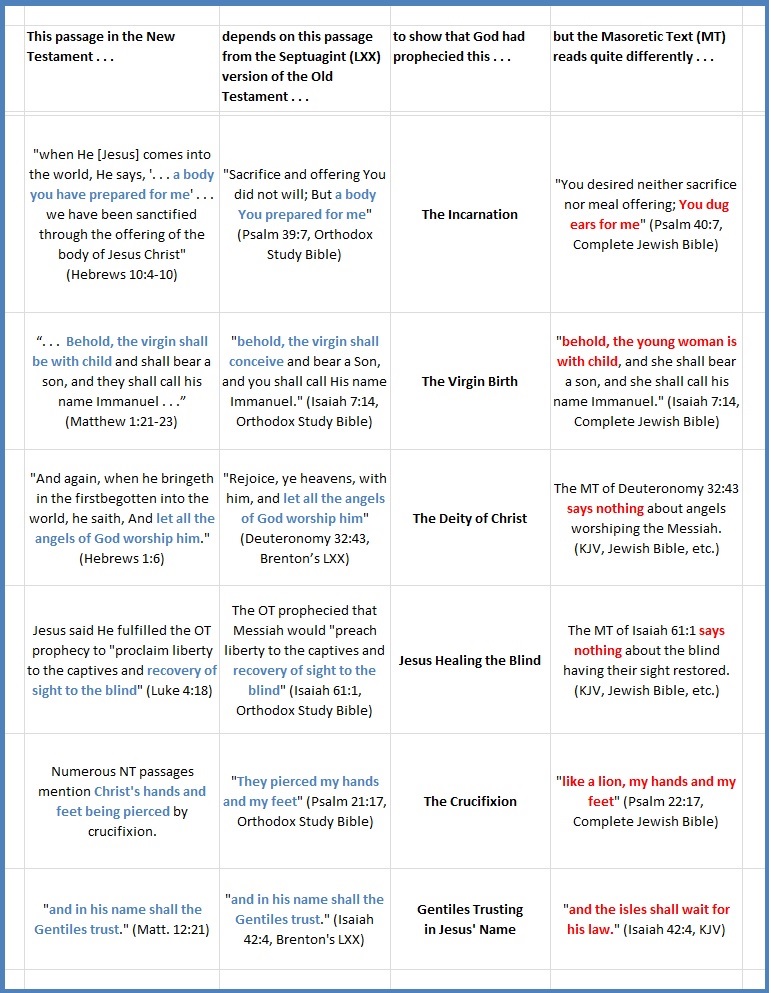
In many places the New Testament authors cited the Old Testament. However, at the time there were multiple versions of the Old Testament, including many Hebrew versions and a Greek translation of the Hebrew called the Septuagint. There are hundreds of cases where there are very significant differences between the commonly accepted Hebrew Masoretic text and the ancient Septuagint, because the Septuagiant was translated from a regional version of Hebrew Bible (in Alexandria) that decidedly differs from today’s Masoretic Hebrew Bible.What this means is that if you compared many new testament quotes of the Old Testament, to your Old testament, you will find the most incomprehensible of differences, and many of these are quite significant:
WHAT DOES THIS MEAN?
At the end of the day, many scholars state that we can be fairly certain about which manuscripts are the earliest and best, but all of them agree that we simply do not have the “original Bible.” We can make a very good educated guess about what the originals contain, based on more than a hundred years of academic work in textual criticism (the science of dating and tracing the history of various handwritten manuscripts of ancient documents). Yet, we simply cannot know what was in the originals because we don’t have them. What we have are reconstructions, made by humans, using logic, reason, and human science (that thing many fideistic religious people just don’t like to trust.)- What we dont have, is the original Bible, and we can't be 100% certain about the exact contents of it.
- What we do have, tells us that ancient documents, including the Bible saw many edits and alterations during copying and transmission.
- What we do have, tells us that there is a high chance for many changes to have occurred between the originals and the earliest copies we have.
- What we do have, tells us we cannot be sure what those changes are, or are not.
- What we do have, is a very good educated reconstruction that attempts to reconstruct the original Bible. Your Bible is the best possible scientific recreation, based on a scientific theory (yes, just like the theory of evolution, which also attempts to reconstruct the past based on available evidence, without access to complete evidence.)
Comments (6)